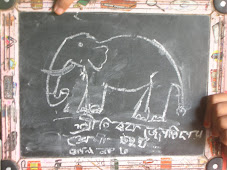
It has been long few days since my last post. On wednesday I boarded a public bus and took a hour ride to the town of Batala to visit two primry schools and interview those who work there.
The mercury in the thermometer was well above 100 degrees and I was really struggling with the heat. It was all worth it to meet some amazing volunteers and the children they teach. The emphasis in Prathams Parrho (read) Punjab program is to change the classroom dymanic in order to increase the speed and quality of the childrens learning. This involves the volunteers nd teachers leading the class in a number of learning games designed to make the class room a more interactive place for the student. In the past, the classroom dynamic consisted of a teacher lecturing while the young students quietly listened and took notes. This method was non existent at the schools I visited where I saw first hand children from each class leading their peers in reciting the alphabet. This was all the more impressive when I was told that only days before the majority of these children had no knowledge of the alphabet. Each child took turns leading the class in the recitation while the volunteer stood by to assist if necessary. In another game instituted by Parrho Punjab a hopskotch-like grid was drawn on the floor with individual letters drawn in each square. The kids, one at a time, were told to jump into a square with the correct letter when the teacher or volunteer prompted them. It was clear from the start that the kids loved this game and they were actually pushing and shoving each other in line so tht their turn could come sooner. I was told later that these and other games were designed with the cultural heritage of the Punjabi people in mind so as to make it even more engaging to the children.
On a more personal note, I am enjoying my time here in Amritsar. It is a very pleasant city (despite the at times unbearable heat) and I cannot wait to go and see its most famous monument, the Golden Temple. This temple is known as the spiritual center of the Sikh religion, similar to St. Peters in Rome and Mecca. The roof is made entitrely out of gold I am told and absolutely spectacular when it is lit up in the evening. In fact I mabout to head there right now. In the next post I shall write bout my time in Jalandar, which is a city two hours south ofAmritsar where I met more great volunteers, childrenand one very enthusiastic government official. Stay tuned...
_____________________________________________________
www.readindia.org
www.pratham.org.uk
www.prathamusa.org
www.pratham.org
Thursday, April 30, 2009


Wednesday, April 29, 2009
Amritsar and beyond
First off I woudld like to apologize in advance for the shortness of this post. I arrived yesterday in Amritsar and took a rickshaw to my hotel after meeting my contact here in the Punjab. I like this region already. It is harvest time and everyone is in the feilds and things are lush, green and very hot. Unfortunately during this time many children are taken out of school to help the family with harvest. To make things worse this is exam period at the end of the school year so these children will not be tested which makes it even harder to gauge any progress made in their education. I will be conducting a number of interviews over the next few days with many people involved with Pratham in the area. The next post shall be filled with information and quotes (hopefully pictures as well) from these volunteers who work hard every day (for no pay) to get these children properly educated. Watch this space.
______________________________________________________
www.readindia.org
www.pratham.org.uk
www.prathamusa.org
www.pratham.org
Sunday, April 26, 2009
Welcome Back!
Hello to everyone. My name is Brent Phippen and I shall be continuing the fledgling tradition of Pratham summer bloggers. I hope that I can continue the high standards set by Pushkar and company last summer. I shall try my best. Before continuing allow me to introduce myself.
I was born in Seattle, Washington which is tucked away in the Pacific Northwest of the United States. For those unfamiliar with Seattle, here is a short list of what the city is famous for: suicidal musicians (including Jimi Hendrix and Kurt Cobain), Starbucks, Mircrosoft and unending rain. At the tender age of three my father uprooted our family and transported us across the Atlantic to London, England. Upon graduating from high school in London I then attended New York University in New York City. I graduated from NYU in January of this year with a degree in History and absolutely no idea of what to do next.
Five years ago a few friends and I visited India. It was during this visit that I first heard of Pratham and the amazing work that they do to not only get young children into school, but ensure that they are learning well, (hence the title of this blog). A few months ago I contacted Pratham asking if I could help in any way and after numerous emails and a very long plane flight, I arrived in New Delhi four days ago.
Tomorrow I will board an early morning train out of New Delhi and ride the rails up to the city of Amritsar in the state of Punjab where I shall begin my work for Pratham in earnest. Along with writing this blog (hopefully daily) I shall also be attached to the Pratham team in Punjab. I shall be conducting interviews with the many people involved in Pratham's volunteer recruiting across Punjab from the rural to district and state levels. The goal of these interviews will be to identify what works well and what needs further improvement in the process of volunteer recruiting in the region. I am chomping at the bit to get started and cannot wait to begin.
I must sign off now as I have to venture out into Delhi to find myself a temporary cell phone for the duration of my time here in India. When I next post in this blog I shall be in Amritsar and settled in a hotel that shall be my home for the next few weeks. Thanks for reading!
______________________________________________________
www.readindia.org
www.pratham.org.uk
www.prathamusa.org
www.pratham.org
Tuesday, September 2, 2008
It's hard being a Pratham Coordinator - Part II
This is in continutation to Pushkar's previous post, here.
In Orissa, we (Pia and I) heard of how one Block Coordinator was abducted by the Naxalites. The reason? No, it wasn't that they were against Pratham's work (they are apparently only anti-state), they were simply very impressed with the coordinator's ability to convince and mobilize the villagers. And they decided to show their appreciation by abducting him and making him work for them. The coordinator stayed with them for some 2-3 days, and could make an escape only when they were transporting him somwhere, and made a stop to eat. He ran, and ran until he was a distance away and could flag a ride to safety.
In Punjab, I was told about how one mobilizer was assured by a girl of her participation as a volunteer over the phone. He called her up to fix up some details, and finally before the commencement of the Summer Camp training he reached her house to pick her up. There, her father accosted him and accused him of eyeing his daughter. He took away the keys of his motorcycle, kept him confined in the house and along with his relatives questioned him as to why he had been calling his daughter so often, and marvelled at his gall to now come and meet his daughter in person. The girl had of course not told her parents about Pratham or her wish to be a volunteer. It took many a-call to the Block and District Coordinators (and some name dropping - "ask the District Education Officer, what Pratham is") for the father to be convinced that it wasn't all a large, spread-out lie to trap his innocent daughter, and for him to release the poor boy.
______________________________________________________
www.readindia.org
www.pratham.org.uk
www.prathamusa.org
www.pratham.org
The Naag Panchami incident and the Pratham legacy
You tend to run into adventures when you’re out there. We arrived at Bahtji village at about 6 o’ clock in the evening. The area was celebrating Naag Panchami by hanging temporary swings on trees, and with...alcohol. It was a fairly large village, and everyone’s eyes were trained on us as we entered in a car too big for those streets. Whose house were we going to, was the unsaid question on their lips. We were there to visit Manisha and Janabai Vakale, 2 of the 4 volunteers of the village. These girls were students of standard 12, and had taught the Anganwadi students in July-October 2007 and during the summer camp.

'Red India' the Pratham sign read at Bahtji
The modest house was filled to capacity by us; there were about 9 of us in about a room of 4 square metres. We were joined by the Upsarpanch of the village. Tea was served and I began to ask my questions about their experience with Pratham so far. As the girls began to speak, the Upsarpanch interrupted – “Excuje me Saar...”, and then he wouldn’t stop. The rest of the conversation was spent trying to keep him quiet.
He imagined that we were here to pay some money to the girls, without his permission or knowledge. And his drunken ego was not going to take that lying down. Here is what I caught of what he said – some intended for me in English, and to impress others – ‘I’m sorry’, ‘I’m a double MA from Baba Saheb Ambedkar University’, ‘ye mulgi’ (‘this girl’), ‘please keep quiet, I am talking’. The repeating refrain, though, was ‘excuse me sir, I’m sorry’.
Pandemonium ensued. People were arguing, shouting, mediating, and suppressing laughter. In all the confusion, the electricity went off. The village men were crowding in to the doorway, curious of us outsiders, blocking all sources of light.
After he attempted a scuffle with our state head (Vishwajit sir), someone led him away. The little interrogation we managed told us that the Panchayat wasn’t forthcoming, and Manisha and Janabai often found it difficult to convince the parents to send their children to the classes. Without the Panchayat’s support, the schools too weren’t supportive. Pratham wasn’t doing as well as it should have been doing, considering their achievements in neighbouring villages, and considering that there were 4 volunteers in the village.
Manisha and Janabai Vakale
If the Vachan programme doesn’t catch their attention immediately, the work of Pratham eventually does. Pratham makes itself known slowly and surely, everywhere I visited, by virtue of its commitment and achievement. The coordinators I spoke to at Aurangabad were full of stories of how the school principal first denied them even the verandah, later gave them a room right next to his own. Stories of how the village collected money to pay the volunteers as a thank-you, how the volunteers were invited by neighbouring villages to teach. How panchayats, parents and schools were waking up to the challenge awaiting them and extending their support to Pratham.
The Naag Panchami incident (as I like to call it) showed me how it would be if Pratham was working without this awareness and support of the village. And of course, it made me realise how important those things were.
In fact, almost everyone I met at Pratham Maharashtra realises that. Everyone at every level – right from Dr Gambhir of the Homi Bhabha Centre for Science Education who was working on the science material, to Vishwajit Sir, to Vijay Chauhan (the block coordinator for Bahtji) to the volunteers - held that one of the biggest achievements of the organisation (and not the most obvious one) was to create enthusiasm in the community about education.
And this environment that Pratham has created not only supports its work, but will outlast the Read India movement and will continue to bear fruit until much later. In fact, that is, I think, the Pratham legacy here.
________________________________________________
www.readindia.org
www.pratham.org.uk
www.prathamusa.org
www.pratham.org
Monday, September 1, 2008
Pratham Maharashtra and its women
Madhuri has been a volunteer for the English pilot programme in her village, Sulikhanjan near Aurangabad. Just out of school and with little familiarity with the language, the task of teaching 20 children must have been daunting. But Madhuri seems a determined girl. This isn’t the biggest adversity she has faced, and she knew she had to make something of her life, to support her family after her father’s passing away. With the help of the continuous training Pratham imparted, the handbook for instructors, and the amazing material (yes amazing, see photo below) provided by them, her job was simplified. It was set into a pattern of studying herself and then teaching what she just learnt.
 An example of the English material provided by Pratham
Her students now boast of a repertoire of 350 words and 50-100 sentences. That is a big achievement when you begin from scratch, and teach for just a few days. And it is an even bigger achievement when the teacher herself begins from near scratch.
But these achievements of Madhuri are more important for the changes they have brought in her life. She has picked up the rudiments of English, and now wishes to learn further. She wishes to teach both English and Mathematics in the phase II of Read India. She has enrolled in the local college for a Bachelors degree. On the basis of her Pratham stint, she has got a job as a teacher at a local private school, the money from which is precious to her family’s subsistence. And she has discovered freedom; the mobility and respect that comes from being a teacher is new to a girl from these parts of the country. And it is treasured above everything else.

An example of the English material provided by PrathamHer students now boast of a repertoire of 350 words and 50-100 sentences. That is a big achievement when you begin from scratch, and teach for just a few days. And it is an even bigger achievement when the teacher herself begins from near scratch.
But these achievements of Madhuri are more important for the changes they have brought in her life. She has picked up the rudiments of English, and now wishes to learn further. She wishes to teach both English and Mathematics in the phase II of Read India. She has enrolled in the local college for a Bachelors degree. On the basis of her Pratham stint, she has got a job as a teacher at a local private school, the money from which is precious to her family’s subsistence. And she has discovered freedom; the mobility and respect that comes from being a teacher is new to a girl from these parts of the country. And it is treasured above everything else.
Madhuri at her home where she also runs the Pratham village library
All over the Maharashtrian countryside, Pratham is changing the lives of the women associated with it. They’re gaining skills, social mobility and greater meaning for themselves. And these women are changing Pratham too. Many of its coordinators and most of its volunteers are women. They are intelligent, outspoken and fiercely loyal. This symbiotic relationship between Pratham Maharashtra and its women is perhaps the most outstanding spin-off of this movement to educate children.
__________________________________________________
www.readindia.org
www.pratham.org.uk
www.prathamusa.org
www.pratham.org
Sunday, August 17, 2008
In Himachal Pradesh the last camps of the nationwide Summer Camp program were running. When I found out a team from Delhi was going to Himachal Pradesh to assess the Summer Camps I decided to join them and see what had been happening in this part of the country. Walking in Himachal Pradesh feels like taking a stroll through a Hindi movie love scene. There were flowers everywhere, and trees heavy with fruit were rustling overhead. The humidity was low and it wasn’t too hot – a blessing after the stifling Delhi weather – and when the clouds came in they wrapped the mountainside in a thin layer of mist and it would drizzle lightly. The mountains rose steeply behind us, but a wide fertile valley opened in front, speckled with paddy fields and winding rivers. Two block coordinators Anuradha and Sangeeta were accompanying us and together we made a merry team, chatting and laughing as we walked.
On the road to one of the camps we paused for a lunch of Sangeeta’s home grown mangos. They were small and yellowish on the inside – but so sweet! Juice ran down our face and hands as we slurped the delicious mango. We were visiting a village built on a tongue of land between two rivers that flood during the monsoon months, making the village inaccessible. We sat eating our mangos on the ridge of the riverbank, overlooking a valley that looked as though it had been untouched for hundreds of years. The village was very picturesque; the buildings were painted in rustic shades of indigo and green and in the cool shade of the verandah were wicker baskets for grain storage. Majestic roosters strutted in the lanes and lines of colorful washing were strung between the trees.
The school was set slightly apart from the rest of the village, standing alone on a small raised area. One room of the school had been opened for the summer camp, and inside we found thirty little faces sitting in their ability groups. Four young volunteers were waiting expectantly for us. It was dark inside the classroom, and I noticed a heap of rubble in one corner. One of the volunteers was newly married, still wearing her bangles and with henna on her hands. She was a little nervous, showing us how she had been using the summer camp material and calling the children up to recite songs and poems for us. There was a wide range of ages and abilities in the classroom. I tested some of the children in the ‘nothing’ group – children who had started the summer camp unable to recognize letters and numbers – and noted that they were all able to read alphabets in Hindi and calculate simple addition and subtraction, although some of the children were so shy that their answers were hardly audible. Some of the older children enjoyed playing with the currency Pratham had prepared for the summer camp. Using notes of 1, 10, 100 and 1000 the children were able to play games while practicing their mental arithmetic skills.
After visiting the school, we went to the home of one of the volunteers for tea. The summer camps had clearly been received well in this village – children had maintained or improved on their learning levels, and the volunteers told us about a rally that they held with the children to cement community support and enthusiasm. Anuradha and Sangeeta had taken the camp children on a picnic – an enormous treat for the children and their families. As we sat and chatted, a few curious children were peeping out of the windows and the sides of the buidings. It started to rain. We all sat around together, sipping our tea and watching the rain.
______________________________________________________
www.readindia.org
www.pratham.org.uk
www.prathamusa.org
www.pratham.org
Subscribe to:
Posts (Atom)